Matter, atom by atom: a guide to atomistic simulation
Why does a material wrinkle, resist heat flow, or separate into thinner layers? The answer often begins with interactions we cannot directly watch. Atomistic simulation builds a model of those atoms so we can test a mechanism, understand a measurement, and decide what to investigate next.
What is atomistic simulation?
It is a way to study matter by representing individual atoms and calculating their behaviour from a physical model. We specify the structure and interactions, then ask how the system responds: which arrangement is stable, how atoms move, or how energy travels through a material.
Think of it as a numerical experiment. The input is a model of a material; the output is evidence about that model. A colourful animation helps us see the mechanism, but the useful result is a quantity we can compare—an energy, a force, a diffusion rate, or a thermal response.
Source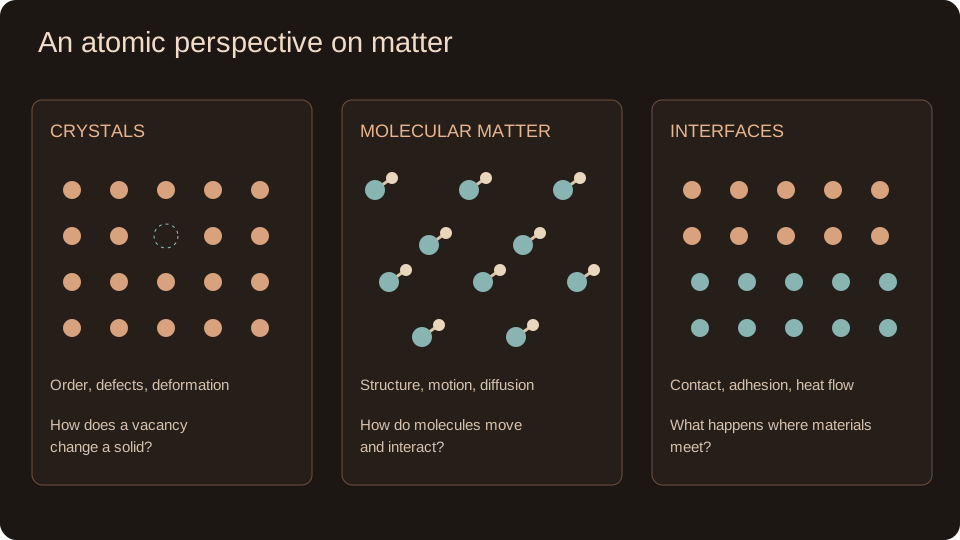
Why look at individual atoms?
An experiment can tell us that a material changes. It may not show which atomic mechanism caused the change. A lower heat-transfer rate, for example, could involve structure, bonding, or the way neighbouring materials interact.
Simulation lets us change one model ingredient at a time, inspect the response, and test competing explanations. That helps narrow the next experiment. The benefit is not certainty: predictions still depend on the interaction model, the system size, the sampled time, and comparison with independent evidence.
SourceHow do we turn a question into a calculation?
Start with a question and a measurable comparison. Build the relevant structure, choose an energy-and-force model, and set the boundaries and conditions. Then select the method: relax the structure, follow motion with molecular dynamics, sample configurations with Monte Carlo, or calculate electronic structure.
For molecular dynamics, forces give accelerations, a numerical integrator advances the atoms, and the calculation repeats. After equilibration, collect enough data to measure the property and its uncertainty. Check that the conclusion survives reasonable changes in time step, box size, and sampling.
Source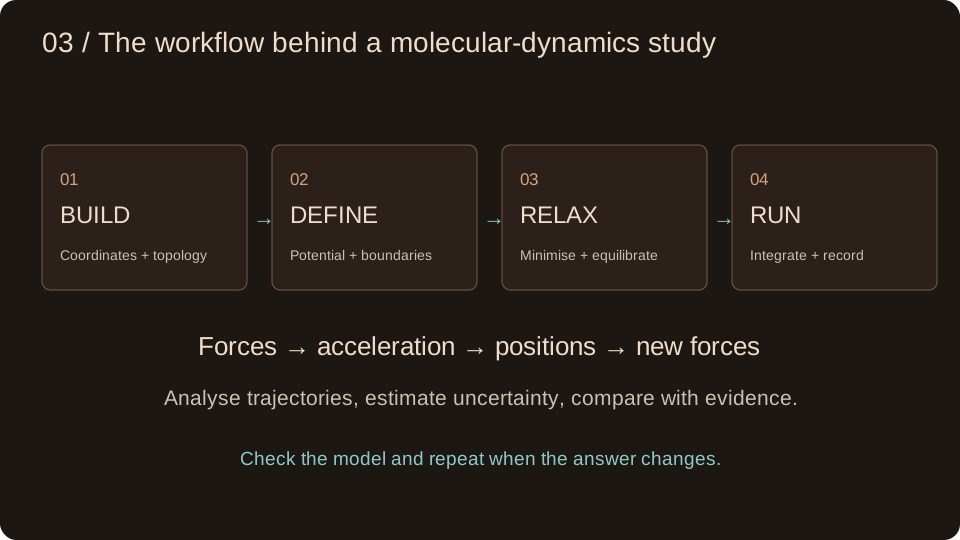
Where does this approach help?
Use an atomic description when local structure and interactions are central to the question: defects and deformation in solids, molecular motion in liquids, adhesion between surfaces, or energy transfer across an interface. The same workflow serves many materials, but the model must change with the physics.
A component-scale temperature field may be better described by a continuum model. Atomistic results can supply a mechanism or an interface property for that larger calculation. The two scales complement one another: resolving every atom is not necessary for every engineering question.
SourceWhich software does what?
PACKMOL: Prepare the system
Packs molecules into a specified region to create initial coordinates without severe overlaps.
Output: a starting configuration. You still need a compatible force field and topology.
Official documentationLAMMPS: Run molecular dynamics
An atomistic simulation engine used for materials, interfaces, liquids, and many other particle systems. Input scripts define the interactions, boundaries, integration, and outputs.
Output: trajectories, energies, temperatures, stresses, and user-defined measurements.
Official documentationGROMACS: Run molecular dynamics
A molecular-dynamics suite widely used for molecular systems, including solvated biomolecules. It provides simulation and trajectory-analysis tools.
Coordinates and topology must agree with the selected force field and water model.
Official documentationOpenMM: Build a simulation in Python
A molecular-simulation toolkit with a Python interface and GPU acceleration. Useful when a workflow needs programmable forces and integration.
A toolkit for calculating motion; the scientific model still needs validation.
Official documentationOVITO: Inspect and analyse
Visualises particle trajectories and extracts structural information from simulation output. Colour atoms by a property, inspect local structure, and build analysis pipelines.
A visualisation and analysis tool; it does not replace the force-field calculation.
Official documentationQuantum ESPRESSO: Calculate electronic structure
A density-functional-theory suite for electronic structure and materials modelling. It can provide energies and forces from a quantum description.
A different level of theory from classical force-field MD, with a different computational cost.
Official documentationReal problems: from atomic questions to practical decisions
Why does deformation change heat transport?
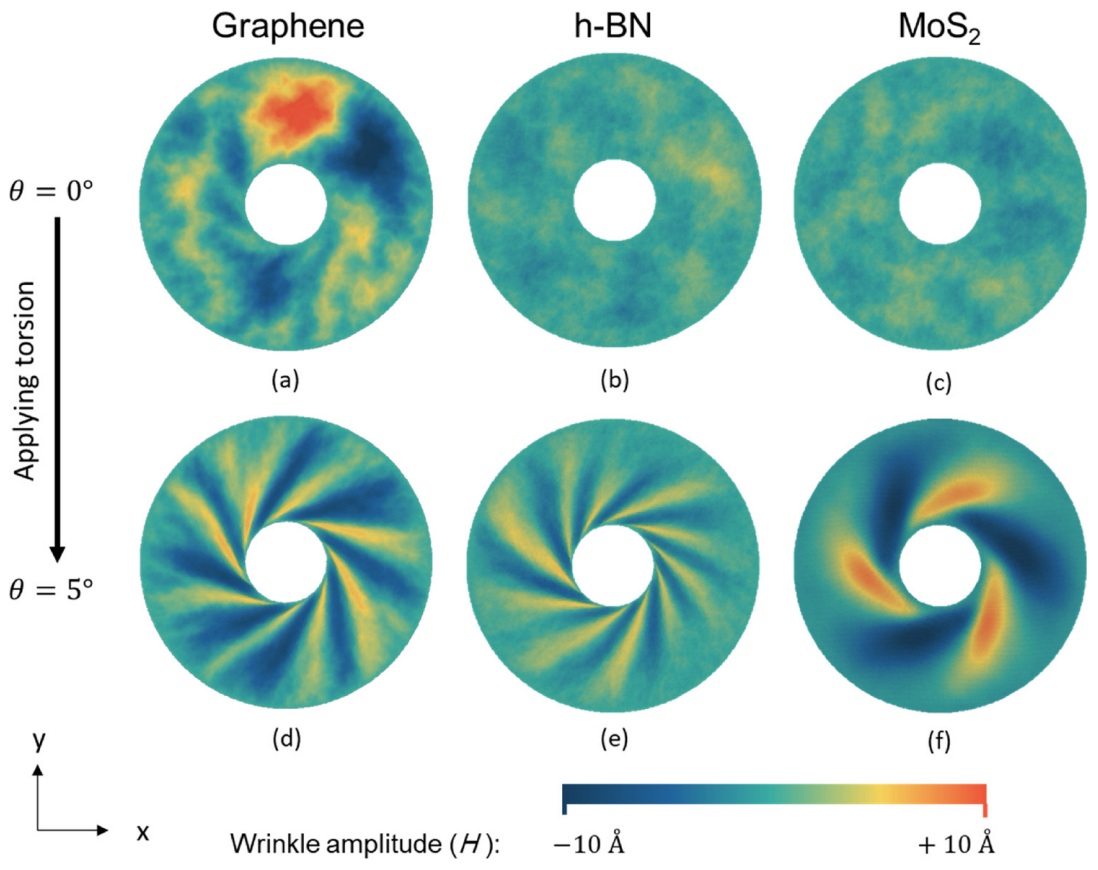
Thin materials can wrinkle under mechanical deformation. We need to understand how that structural change affects their ability to carry heat.
Compare the sheets before and after torsion. Atomistic models resolve wrinkles in graphene, h-BN, and MoS₂, helping connect deformation to changes in thermal transport. Use the shared height colour scale to compare wrinkle amplitudes.
Relate a controllable deformation to material response, then test the trend for the intended geometry and conditions.
How does gas flow separate layered materials?
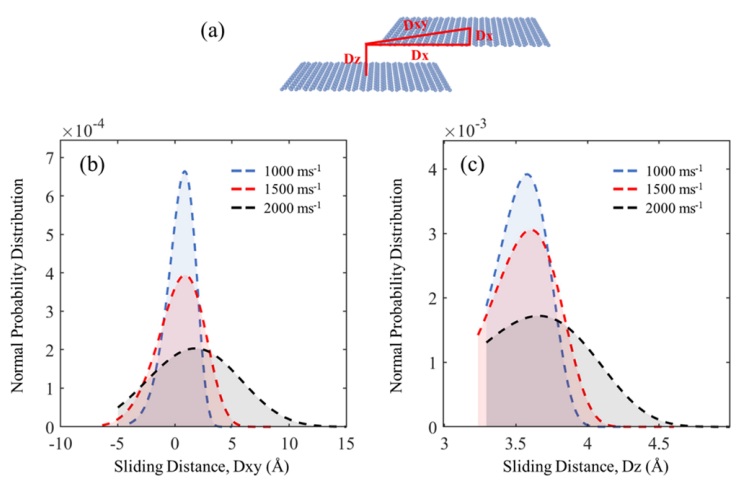
Producing thinner sheets requires understanding how momentum from a gas stream moves neighbouring layers.
The sliding and vertical-distance distributions distinguish different components of graphene motion under gas flow. Compare their axes carefully: they use different distance scales. A trajectory helps test the mechanism behind a processing step.
Identify the motion involved in exfoliation and use it to guide processing questions; an atomic trajectory alone does not establish manufacturing performance.
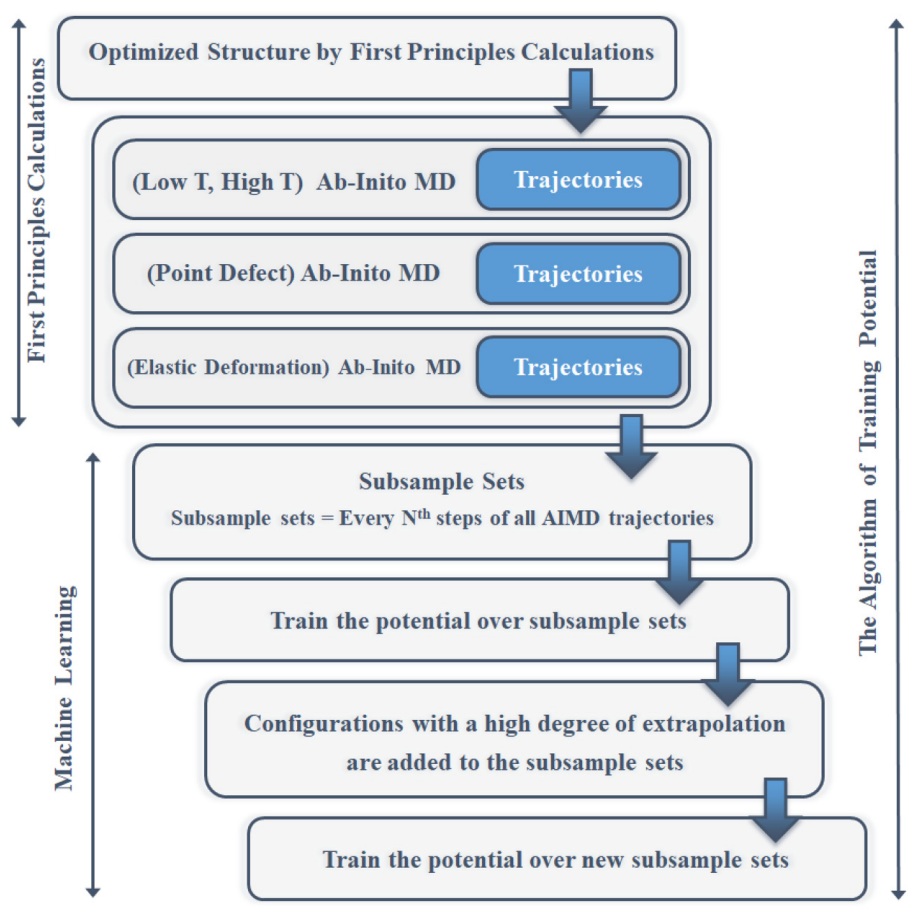
How can we study more atoms without losing useful accuracy?
Electronic-structure calculations can provide valuable forces, but their cost limits the systems and times we can explore.
This figure from my perspective article connects reference configurations, training, and an interatomic potential. A learned model can make larger calculations practical, but its reliability depends on reference-data coverage and validation.
Learn an interatomic potential from reference data, then validate it before using it for larger calculations. Speed does not guarantee transferability.
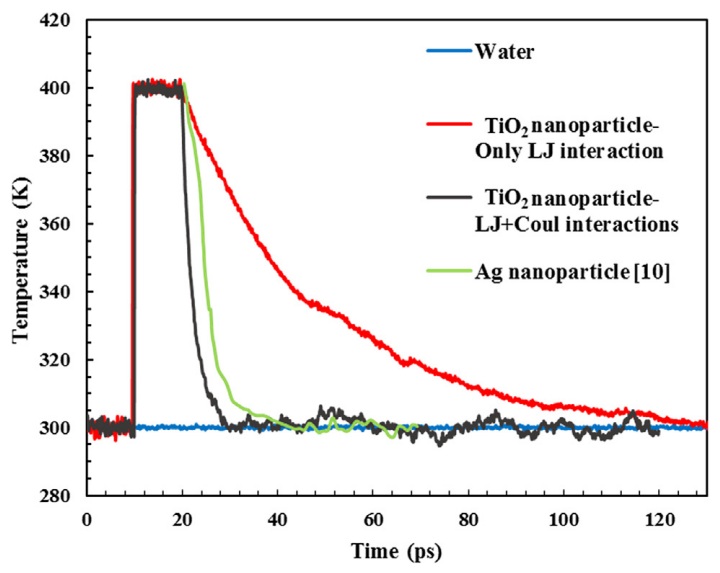
What controls heat crossing a material–liquid interface?
A hot nanoparticle must release energy through its contact with the surrounding liquid. The interface can limit that transfer.
Compare the red TiO₂ curve (Lennard–Jones only) with the black curve (Lennard–Jones plus Coulomb). Removing electrostatics slows cooling markedly. It also changes the interfacial structure, so this is not an isolated subtraction of one heat-transfer channel.
Test how the interaction model changes the predicted cooling mechanism, and use the result to motivate better interface measurements and models.
Key takeaways
What: represent a material through individual atoms and their interactions.
Why: test the microscopic mechanisms behind an observed response.
How: build, calculate, measure, and validate a model matched to the question.
Where: use atomic detail when structure and interactions matter, and connect it to larger-scale models when needed.
Real problems: turn trajectories and energies into evidence that can guide the next research or engineering decision.
Common questions
Is atomistic simulation the same as molecular dynamics?
No. Molecular dynamics is one atomistic method. Energy minimisation, Monte Carlo sampling, and electronic-structure calculations answer other questions; some of these approaches can also be combined.
Are the moving spheres real images of atoms?
No. They visualise atomic coordinates. Radii, colours, and playback speed are display choices. Quantitative conclusions come from the underlying model and analysis.
Can a simulation show chemical reactions?
Only if its description of interactions supports them. Fixed-topology models do not create or break covalent bonds. Reactive potentials and suitable electronic-structure methods can describe changing connectivity within their range of validity.
Can simulations replace experiments?
They can test mechanisms and reveal quantities that are difficult to measure directly. Experiments and independent reference calculations remain important checks on whether a model describes the real system.